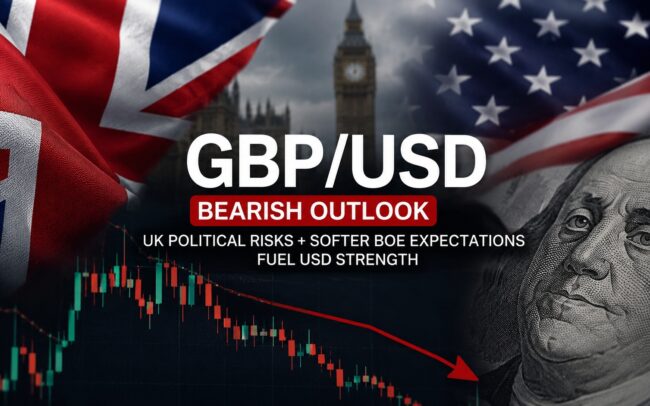



The GBP/USD pair continues to face sustained downside pressure as a confluence of macroeconomic, political, and technical factors align against the British pound. With multiple leading financial institutions maintaining a bearish outlook, traders are increasingly positioning for further declines, particularly as key political events in the UK approach.
Fundamental Outlook: Political Uncertainty Weighs on GBP
One of the primary drivers behind the bearish sentiment is rising political instability in the United Kingdom. Following Labour’s disappointing performance in recent local elections, internal party tensions have intensified. Market participants are closely watching the upcoming June 18 by-election, where Andrew Burnham is expected to play a pivotal role. A potential leadership challenge to Prime Minister Keir Starmer during the July–August period could inject further volatility into GBP pairs. Historically, political uncertainty tends to weaken investor confidence, and the pound is no exception.
In parallel, monetary policy expectations are shifting. Inflation expectations in the UK have softened, prompting investors to scale back bets on further Bank of England rate hikes. This reduces the yield attractiveness of GBP relative to the US dollar, especially as the Federal Reserve maintains a more hawkish stance.
USD Strength: Safe-Haven Demand and Yield Support
The US dollar remains well-supported by both macro fundamentals and geopolitical developments. Escalating tensions in the Middle East, combined with rising oil prices, have triggered a risk-off environment, boosting safe-haven demand for the dollar. The US Dollar Index hovering near the 99.20–99.40 range reflects this strength.
Additionally, US 10-year Treasury yields remain elevated at 4.457%, reinforcing USD demand. Strong inflation dynamics and resilient economic growth continue to justify the Federal Reserve’s firm stance, further widening the policy divergence between the Fed and the Bank of England.
Technical Analysis: Clear Downtrend Structure
From a technical perspective, GBP/USD remains firmly bearish. The pair is currently trading at 1.3445, below all key moving averages:
200-day MA: 1.3423
50-day MA: 1.3443
100-day MA: 1.3476
This alignment confirms a strong bearish trend structure. Momentum indicators such as RSI (48.3) and stochastic (47.0) suggest neutral-to-bearish conditions, leaving room for further downside.
Key levels to watch:
Support: 1.3390 → 1.3337 → 1.3306
Resistance: 1.3420 (pivot) → 1.3470 zone
A sustained break below 1.3390 could accelerate selling pressure.
Market Positioning and Sentiment
CFTC data shows GBP net positioning remains deeply negative at -61,398 contracts, confirming institutional bearish bias. Meanwhile, retail traders are heavily skewed toward long positions in GBP crosses such as GBPCHF and GBPNZD, which historically acts as a contrarian indicator—favoring further downside.
Trade Idea: Sell GBP/USD on Strength
Given the alignment of bearish fundamentals, technical weakness, and positioning data, the preferred strategy remains selling rallies.
Entry Zone: 1.3420 – 1.3460
Stop Loss: Above 1.3500
Target 1: 1.3337
Target 2: 1.3300
Extended Target: 1.3250
Alternatively, a breakout strategy can be considered:
Sell on break below 1.3390
Target: 1.3300 and lower
Conclusion: Downside Risks Dominate
GBP/USD is entering a critical phase where political risk, weakening monetary expectations, and strong USD fundamentals converge. With traders waiting for confirmation from the June 18 by-election, volatility is expected to increase. Unless there is a significant shift in UK political stability or a dovish pivot from the Fed, the path of least resistance remains to the downside.
For now, rallies should be viewed as selling opportunities in a broader bearish trend.